 Login / Register


 United States ($) USD
 Austria (€) EUR
 Belgium (€) EUR
 Finland (€) EUR
 France (€) EUR
 Germany (€) EUR
 Ireland (€) EUR
 Japan (¥) JPY
 Luxembourg (€) EUR
 Netherlands (€) EUR
 Switzerland (CHF) CHF
 United Kingdom (£) GBP

- Clone
- W19256A (See other available formats)
- Regulatory Status
- RUO
- Other Names
- ETS-Related Gene, Transcriptional Regulator ERG, ETS Transcription Factor ERG, Erythroblast Transformation-Specific Transcription Factor ERG Variant 10, p55
- Isotype
- Rat IgG2a, κ
- Ave. Rating
- Submit a Review
- Product Citations
- publications

-

HeLa cells (negative control, panel A) and MOLT-4 cells (positive control, panels B and C) were fixed with 4% PFA Fixation Buffer (Cat. No. 420801), permeabilized with ice-cold methanol, and blocked with 5% FBS. The cells were then stained with Alexa Fluor® 647 anti-ERG (clone W19256A), and nuclei were counterstained with DAPI (Cat. No. 422801). Panels A and B show representative images for the DAPI and Alexa Fluor® 647 channels merged while panel C shows only the Alexa Fluor® 647 channel. Images were captured using a Revvity Operetta CLS™ High Content Analysis System with a 63X objective. Scale bar: 50 µm -

U937 cells (negative control, open histogram) and MOLT-4 cells (positive control, filled histogram) were fixed and permeabilized using True-Nuclear™ Transcription Factor Buffer Set (Cat. No. 424401) and intracellularly stained with Alexa Fluor® 647 anti-ERG (clone W19256A) or Alexa Fluor® 647 Rat IgG2a, κ Isotype Control (Cat No. 400526) (open histogram, dashed line. Representative for both cell lines).
| Cat # | Size | Price | Quantity Check Availability | Save | ||
|---|---|---|---|---|---|---|
| 940203 | 25 µg | 148€ | ||||
ERG (ETS-related gene) is a member of the erythroblast transformation-specific (ETS) family of transcription factors. Expressed in the mesoderm and endothelium of embryos, ERG is vital to embryonic cell differentiation as well as regulation of endothelial homeostasis, a role it sustains beyond the embryonic stage. Through transcriptional regulation of VE-cadherin, ICAM-2, and Claudin-5, ERG maintains endothelial junctional integrity and stability and regulation of the endothelial cytoskeleton through its interactions with HDAC6 and RhoJ. ERG is vital to angiogenesis, bone development, platelet adhesion, urogenital tract development, vascular stability, and proper hematopoiesis regulation. It plays a large role in cellular response to vascular inflammation, endothelial cell barrier function, and inhibition of vascular inflammation. These functions are accomplished largely through ERG-mediation of the Wnt/β-catenin signaling pathway by means of transcriptional regulation of FZD4 and VE-cadherin by ERG and subsequent promotion of β-catenin stability. This in turn promotes endothelial cell proliferation. ERG fusion proteins resulting from chromosomal translocations cause ERG to behave as a proto-oncogene, contributing to prostate cancer, megakaryoblastic leukemia, and Ewing’s sarcoma.
Product DetailsProduct Details
- Verified Reactivity
- Human
- Antibody Type
- Monoclonal
- Host Species
- Rat
- Immunogen
- Partial recombinant human ERG protein
- Formulation
- Phosphate-buffered solution, pH 7.2, containing 0.09% sodium azide
- Preparation
- The antibody was purified by affinity chromatography and conjugated with Alexa Fluor® 647 under optimal conditions.
- Concentration
- 0.5 mg/mL
- Storage & Handling
- The antibody solution should be stored undiluted between 2°C and 8°C, and protected from prolonged exposure to light. Do not freeze.
- Application
-
ICC - Quality tested
ICFC - Verified - Recommended Usage
-
Each lot of this antibody is quality control tested by immunocytochemistry. For immunocytochemistry, a concentration range of 5.0 - 10.0 μg/mL is recommended. For flow cytometric staining, the suggested use of this reagent is ≤ 0.06 µg per million cells in 100 µL volume. It is recommended that the reagent be titrated for optimal performance for each application.
* Alexa Fluor® 647 has a maximum emission of 668 nm when it is excited at 633 nm / 635 nm.
Alexa Fluor® and Pacific Blue™ are trademarks of Life Technologies Corporation.
View full statement regarding label licenses - Excitation Laser
-
Red Laser (633 nm)
- Application Notes
-
For use of this antibody in Immunocytochemistry (ICC), we recommend fixation with PFA fixation Buffer (Cat. No. 420801) followed by permeabilization with either Triton X-100 (0.5 %) or ice-cold methanol.
For use of this antibody in intracellular flow cytometry (ICFC), we recommend fixation and permeabilization using True-Nuclear™ Transcription Factor Buffer set (Cat. No. 424401) or True-Phos™ Perm Buffer (Cat. No. 425401).
Antigen Details
- Structure
- ERG is a 449 amino acid protein with an expected molecular weight of 54 kD.
- Distribution
-
Ubiquitously expressed/ Nucleus
- Function
- Transcription factor
- Cell Type
- Endothelial cells
- Biology Area
- Cell Biology, Ubiquitin/Protein Degradation
- Antigen References
-
1. Adamo P, et al. 2016. J. Biol. Chem. 35:4013
2. Birdsey G, et al. 2015. Dev. Cell. 32:82
3. Shah A, et al. 2016. Vascul. Pharmacol. 86:3 - Gene ID
- 2078 View all products for this Gene ID
- UniProt
- View information about ERG on UniProt.org
Related Pages & Pathways
Pathways


Related FAQs
Other Formats
View All ERG Reagents Request Custom Conjugation| Description | Clone | Applications |
|---|---|---|
| Purified anti-ERG Antibody | W19256A | WB,IP,ICC,ICFC |
| Alexa Fluor® 647 anti-ERG | W19256A | ICC,ICFC |
Compare Data Across All Formats
This data display is provided for general comparisons between formats.
Your actual data may vary due to variations in samples, target cells, instruments and their settings, staining conditions, and other factors.
If you need assistance with selecting the best format contact our expert technical support team.
-
Purified anti-ERG Antibody
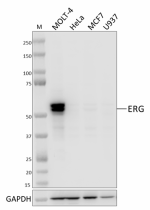
Whole cell extracts (15 µg total protein) from MOLT-4 (high ... 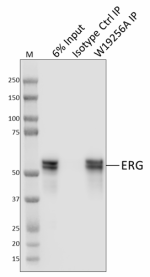
Whole cell extracts (250 µg total protein) prepared from MOL... 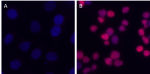
HeLa cells (negative control) (panel A) and MOLT-4 cells (po... 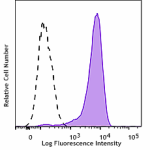
MOLT4 cells (filled histogram, positive control) or U937 cel... -
Alexa Fluor® 647 anti-ERG

HeLa cells (negative control, panel A) and MOLT-4 cells (pos... 
U937 cells (negative control, open histogram) and MOLT-4 cel...


Follow Us